
Medically reviewed by Dr. Eva Mackey Meyrat, MD, board-certified in Family Medicine.
Yes. A direct primary care membership covers your everyday care, and it is not insurance and does not replace it. It does not cover surgery, a hospital stay, an emergency room visit, specialist treatment or imaging at a hospital. The pairing that works is a membership for the care you use often, plus a plan for the things that would otherwise be financially ruinous.
What membership actually covers
Everyday primary care, in full, for a flat monthly fee rather than per visit.
At Gem MD that means sick visits, annual physicals, and ongoing management of chronic conditions including diabetes, hypertension, thyroid disorders, high cholesterol, asthma and COPD. It includes women's health, covering annual exams, pap smears and IUD removal, with insertion coordinated through a specialist referral. It includes pediatric care from newborn through age 20, with well-child checks and school and sports physicals.
Most in-office tests are included at no charge, and anything sent out goes to partner labs at published cash prices, so the figure is one you see before you agree to it.
What that adds up to is the category of care you use many times a year, at a cost you know in advance. Full details are on the family medicine page.
What membership does not cover
The expensive half of medicine, which a membership does not touch.
A membership does not pay for:
- Surgery, inpatient or outpatient
- A hospital admission, including the stay, the imaging and the specialists involved
- An emergency room visit
- Specialist treatment outside primary care, such as cardiology, oncology or orthopedics
- Hospital-based imaging, such as MRI or CT
- Prescription medication, which you buy from a pharmacy
Any one of those can arrive as a bill of an entirely different order from anything primary care deals with. That is the risk insurance exists to carry, and a membership does not carry it. If you drop coverage entirely and something serious happens, the membership will not help you with the bill.
Why the two work well together
Because they cover opposite halves of the problem, and most plans are poorly matched to the half you actually use.
A high-deductible plan is cheap per month and expensive per visit. That shape is a bad deal for the ordinary appointments a family needs across a year, which is exactly why people put them off. It is a good deal for the catastrophic event, which is what a deductible is designed for.
A membership inverts that. Predictable monthly cost, unlimited everyday access, nothing per visit.
Pair them and the routine care stops being a reason to hesitate, while the catastrophic risk stays covered. The money question, worked through side by side, is in our DPC versus insurance cost comparison, which also covers how the model works if it is new to you.
What to look at during open enrollment
Open enrollment on HealthCare.gov opens November 1. Texas has a federally facilitated marketplace rather than a state-run one, so HealthCare.gov is where a plan outside an employer comes from. Check the closing date there yourself rather than trusting a date printed in an article: deadlines move, state-run exchanges differ from the federal one, and the date that applies to you is the one on the site.
What to actually compare, if you are pairing a plan with a membership:
| Look at | What it does alongside a membership | |---|---| | The deductible and out-of-pocket maximum | This is the number that matters now, since it is what you are actually buying the plan for | | Whether it is HSA-eligible | A high-deductible plan can pair with an HSA, and since January 2026 a membership can be paid from one. The limit for 2026 is $150 a month for one person, or $300 where the membership covers more than one, and both are indexed to inflation after 2026. Above the limit you can still pay the fee from an HSA, but you cannot put new money into the HSA while you are enrolled | | Hospital and specialist network | Where you would be admitted and referred, which is the half the plan covers | | Prescription coverage | Membership does not cover medication, so this is a real line item | | The primary care copay | Worth noticing how little you will use it, and pricing the plan accordingly |
On the HSA question specifically, read HSA eligibility for 2026 before you choose, because it changes which plan shape makes sense.
Two other options worth knowing about
A health care sharing arrangement. Gem MD has a Sedera Health Share partnership available to members. A sharing arrangement is not insurance and does not work like it, so read what it does and does not cover carefully before relying on it for a large medical event.
Employer coverage. If you run a business, enrolling three or more employees gets discounted rates with the registration fee waived. That pairs a real primary care benefit with whatever plan you already offer, and it is often how a small employer improves benefits without changing carriers. Details are on the employers page.
Which insurers the practice works alongside is on coverage, and what membership costs is on membership.
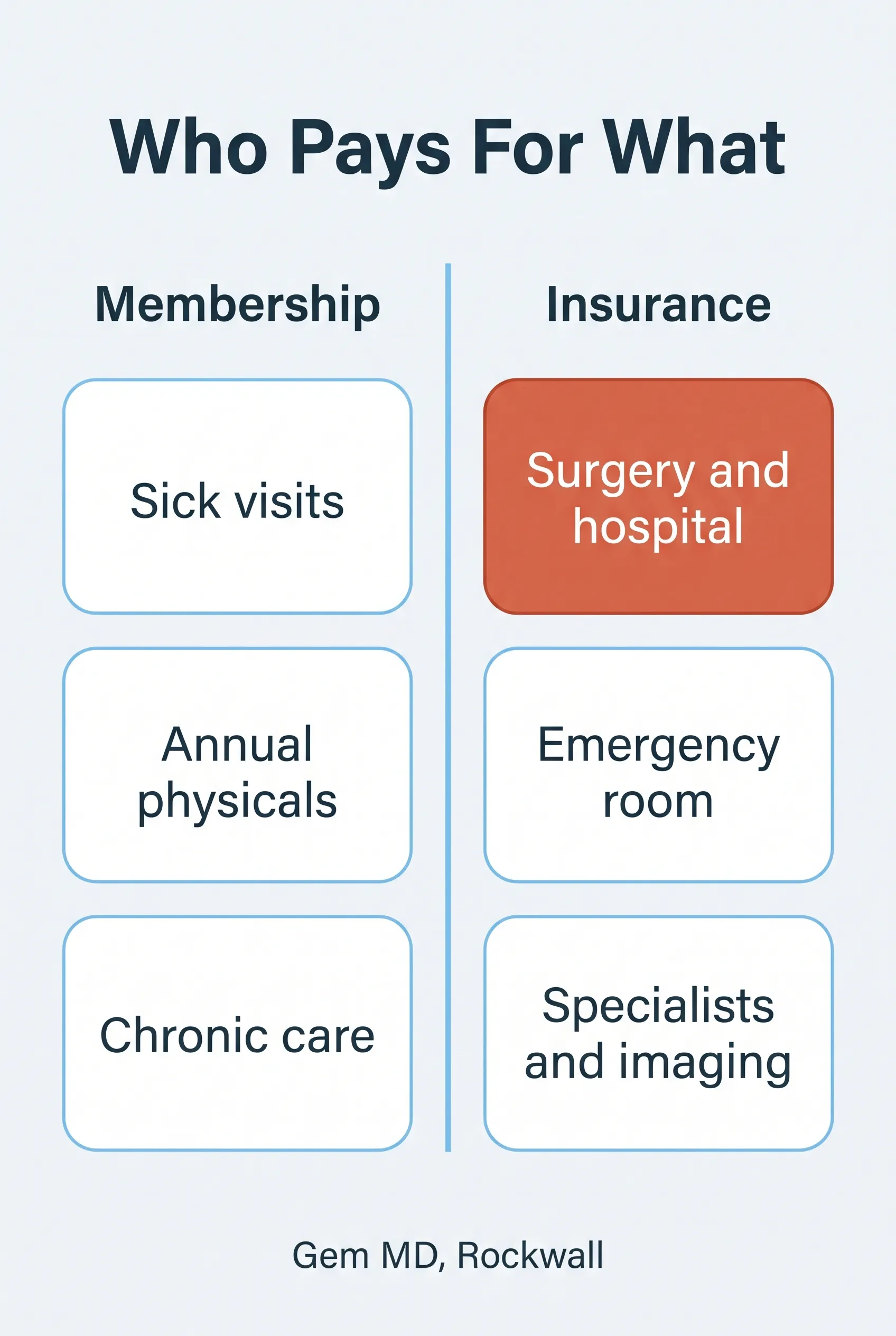
The split, as text. Who Pays For What, Membership against Insurance. Sick visits: Membership. Annual physicals: Membership. Chronic care: Membership. Surgery and hospital: Insurance. Emergency room: Insurance. Specialists and imaging: Insurance. Prescription medication is bought from a pharmacy and is not in either column. You need both halves. Gem MD, Rockwall.
Call (972) 961-4171 if you want to talk through how a membership would sit alongside the plan you are considering.
Frequently asked questions
Is direct primary care a replacement for health insurance?
No. It covers everyday primary care and nothing else, so surgery, a hospital stay, an emergency room visit, specialist treatment and hospital imaging are all outside it. Dropping coverage and relying on a membership alone leaves you exposed to exactly the bills that bankrupt people. The two are designed to pair, with the membership handling what you use often and the plan carrying the catastrophic risk.
What kind of insurance plan pairs best with a membership?
Generally a plan built for catastrophic cost rather than routine visits, since the membership already covers the routine half. That usually means paying attention to the deductible, the out-of-pocket maximum, the hospital and specialist network, and prescription coverage, rather than the primary care copay you will rarely use.
Whether the plan is HSA-eligible matters too. Since January 2026 a membership can be paid from an HSA, with a 2026 limit of $150 a month for one person or $300 where the membership covers more than one person. Above that limit the fee is still payable from an HSA, but new contributions are not allowed while you are enrolled. One thing worth asking about any membership: the rule only treats it this way if what you are paying for is primary care, so a fee that bundles in prescriptions or hospital-type lab work falls outside it.
When can I change my insurance plan?
Open enrollment on HealthCare.gov opens November 1, and Texas has a federally facilitated marketplace rather than a state-run one. Confirm your own closing deadline on HealthCare.gov rather than relying on a date in an article, since deadlines move and state exchanges differ. Outside that window you generally need a qualifying life event. A Gem MD membership is not tied to open enrollment and can start at any time.
Does membership cover my prescriptions?
No. Medication is purchased from a pharmacy and is not part of the membership, which is why prescription coverage is worth checking on any plan you compare. Membership covers the visit where a medication is prescribed, the follow-up where a dose is adjusted, and the monitoring in between, with most in-office tests included at no charge.