
Medically reviewed by Dr. Eva Mackey Meyrat, MD, board-certified in Family Medicine.
Neither medication is something you pick. Both carry hard contraindications on their FDA labels, and those decide the question before preference enters it: semaglutide and tirzepatide each carry a boxed warning, and phentermine is ruled out by a list longer than most people expect. There is no fixed order between them. Your history and your labs settle it.
The short version
Semaglutide or tirzepatide is off the table if you have a personal or family history of medullary thyroid carcinoma, or Multiple Endocrine Neoplasia syndrome type 2, or you have had a serious reaction to the drug. Those are contraindications on the label, not preferences.
Phentermine is off the table if you have a history of cardiovascular disease, have taken a monoamine oxidase inhibitor in the last 14 days, or have hyperthyroidism, glaucoma, an agitated state, a history of drug abuse, or are pregnant or nursing. It is also indicated for only a few weeks, so it does not answer a question about ongoing management.
Both can be off the table, and that is a legitimate outcome of a first visit. Where neither is ruled out, which one is considered comes out of your history, your labs and the conversation. It is a prescribing decision, and this article does not make it for you.
This article is general information about drug labels. It is not a recommendation for you, and nobody can make one without your history and your bloodwork. What the weight management program includes is on the weight management page.
What each medication actually does
They work on completely different systems, which is why the contraindications have nothing in common.
Semaglutide acts on the receptor for glucagon-like peptide-1, a hormone your gut releases that signals fullness and slows digestion. Tirzepatide is not the same molecule doing the same thing: its label describes it as a GIP receptor and GLP-1 receptor agonist, binding and activating both, so calling it a GLP-1 is shorthand rather than a description. Both are used at Gem MD. Patients generally describe feeling satisfied on less food and thinking about food less across the day.
Phentermine is a sympathomimetic amine. It acts on appetite and energy more directly, which makes a reduced-calorie plan easier to hold to without constant hunger working against it. It is a DEA Schedule IV controlled substance.
What the boxed warning says
Plain language, because a footnote is the wrong place for it.
Both drugs carry their own boxed warning for thyroid C-cell tumors: semaglutide's FDA prescribing information (Wegovy, revised 6/2026) and tirzepatide's (Zepbound, revised 8/2026). In rodents, each causes dose-dependent and treatment-duration-dependent thyroid C-cell tumors at clinically relevant exposures. Both labels state it is unknown whether the drug causes medullary thyroid carcinoma in humans.
What follows from that:
- Each is contraindicated in anyone with a personal or family history of **medullary thyroid
carcinoma (MTC), and in anyone with Multiple Endocrine Neoplasia syndrome type 2 (MEN 2)**. A prior serious hypersensitivity reaction to that drug or any of its excipients is also a contraindication.
- Both labels describe routine serum calcitonin measurement and thyroid ultrasound as **of uncertain
value** for early MTC detection, and note that such monitoring may lead to unnecessary procedures. No screening test resolves this, so the family history is what the contraindication rests on.
- Patients are counselled to report **a mass in the neck, difficulty swallowing, shortness of breath
or persistent hoarseness**.
Family history is the reason the first visit asks about relatives' cancers. It is not box-ticking.
What rules out phentermine
Phentermine's label is restrictive in a different direction, and the restrictions are common conditions rather than rare ones.
The label's contraindications, in full, are a history of cardiovascular disease (it names coronary artery disease, stroke, arrhythmias, congestive heart failure and uncontrolled hypertension), use during or within 14 days of a monoamine oxidase inhibitor, hyperthyroidism, glaucoma, agitated states, a history of drug abuse, pregnancy, nursing, and known hypersensitivity or idiosyncrasy to the sympathomimetic amines.
Four of those have nothing to do with the heart, which is why they catch people out: an overactive thyroid, glaucoma, an agitated state and a history of drug abuse each rule the drug out on their own.
Beyond the outright contraindication, the label advises caution even in mild hypertension, because the drug can raise blood pressure further.
The label also notes rare cases of primary pulmonary hypertension and says to stop the drug if new unexplained shortness of breath, chest pain, fainting or swelling in the lower legs appears.
And one structural limit that gets glossed over: phentermine is indicated as short-term therapy, described on the label as a few weeks, for exogenous obesity. It is not designed as an indefinite treatment. If what you need is ongoing management, that is a real argument against it regardless of your heart history.
The two labels, side by side
| | Semaglutide, tirzepatide | Phentermine | |---|---|---| | How it works | Acts on the GLP-1 receptor, signalling fullness and slowing digestion. Tirzepatide acts on the GIP receptor too | Sympathomimetic amine, acts on appetite and energy | | Intended duration | Ongoing management | Short-term, a few weeks per the label | | Boxed warning | Yes, thyroid C-cell tumors, on each label | No | | Ruled out by | Personal or family history of MTC, MEN 2, prior serious hypersensitivity | History of cardiovascular disease, MAOI within 14 days, hyperthyroidism, glaucoma, agitated states, history of drug abuse, pregnancy, nursing, hypersensitivity to sympathomimetic amines | | Use caution with | Reported symptoms of thyroid tumors | Even mild hypertension | | Controlled substance | No | Yes, DEA Schedule IV | | Common experience | Reduced appetite, nausea and digestive changes reported | Reduced appetite, effect on energy |
Sources: semaglutide FDA prescribing information (Wegovy, revised 6/2026); tirzepatide FDA prescribing information (Zepbound, revised 8/2026); phentermine FDA prescribing information (Adipex-P, revised 3/2024), all via DailyMed.
The downside of each
A comparison that only lists the other option's problems is not a comparison.
The semaglutide and tirzepatide downside is the boxed warning and the fact that human relevance is unresolved rather than ruled out, plus side effects that are real: nausea and digestive changes are the ones patients most often report, and dose adjustments exist partly to manage them. It also means ongoing prescribing and monitoring rather than a short course.
The phentermine downside is that it is a controlled substance with a short-term indication, which means it does not answer the question of what happens after a few weeks. Its contraindication list also rules out a meaningful share of the people who ask about weight management, because cardiovascular disease and uncontrolled hypertension are common.
What the first visit actually determines
At Gem MD, weight management starts with a conversation and bloodwork, not a prescription pad. That sequence exists because of everything above: neither drug can be chosen from a questionnaire.
Your provider goes through your health history, your family history, your current medications and your labs. Lab work is run before GLP-1 therapy is started. Appointments run 30 to 60 minutes, which is the amount of time that conversation actually needs.
If you start a medication, the physician monitors side effects, adjusts the dose, and rechecks labs later to confirm the plan is still working and still appropriate. Because weight management sits inside the Direct Primary Care membership, a follow-up visit to adjust a dose or talk through a side effect is not a separate copay, which is the practical reason monitoring actually happens rather than being skipped.
If you want the week-to-week picture of GLP-1 therapy rather than the comparison, read what to expect on GLP-1 treatment. Membership details are on membership.
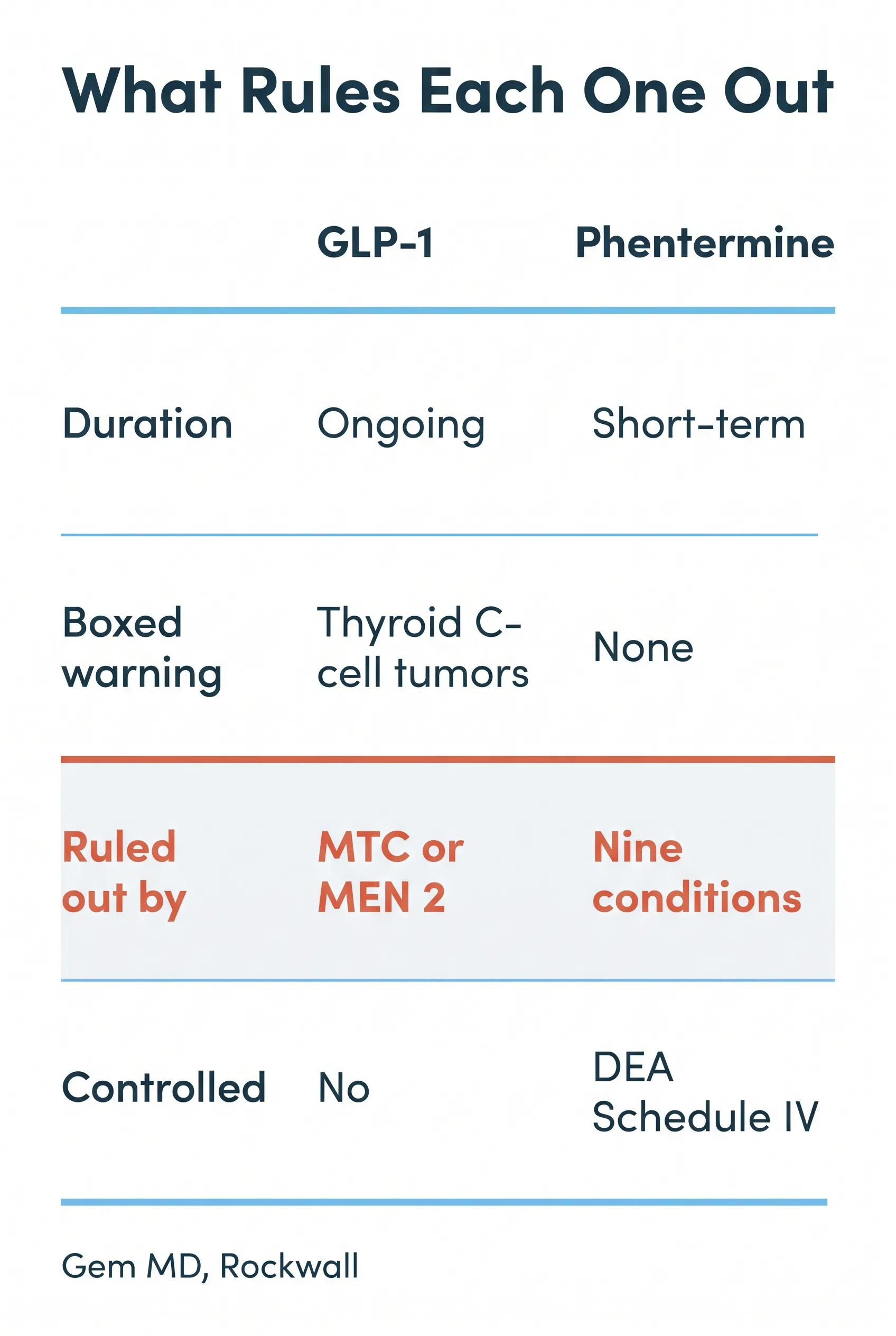
The comparison, as text. What Rules Each One Out, GLP-1 against Phentermine. Duration: Ongoing for a GLP-1, Short-term for phentermine. Boxed warning: Thyroid C-cell tumors for a GLP-1, None for phentermine. Ruled out by: MTC or MEN 2 for a GLP-1, Nine conditions for phentermine. Controlled: No for a GLP-1, DEA Schedule IV for phentermine. Your labs and history decide which, and both may be ruled out. Gem MD, Rockwall.
Call (972) 961-4171 to ask about an evaluation.
Frequently asked questions
Can I ask my doctor for phentermine instead of a GLP-1?
You can raise it, and it is a reasonable question if you have had a poor experience with a GLP-1 or cannot take one. What you cannot do is choose it around its label: phentermine is contraindicated in a history of cardiovascular disease including coronary artery disease, stroke, arrhythmias, congestive heart failure and uncontrolled hypertension, within 14 days of an MAOI, and in hyperthyroidism, glaucoma, agitated states, a history of drug abuse, pregnancy and nursing. At Gem MD the decision follows your history and bloodwork, which is why the first visit runs 30 to 60 minutes rather than being a prescription request.
Why does my doctor ask about my family's thyroid cancer history?
Because semaglutide and tirzepatide are both contraindicated in anyone with a personal or family history of medullary thyroid carcinoma, or with Multiple Endocrine Neoplasia syndrome type 2, under the boxed warning each carries on its FDA label. Both labels also describe routine calcitonin testing and thyroid ultrasound as of uncertain value for early detection, so there is no screening test that substitutes for knowing the family history. It is the single question that can rule the medication out on its own.
Is phentermine meant to be taken long term?
No. Its FDA label indicates it as short-term monotherapy, described as a few weeks, for the management of exogenous obesity, and it is a DEA Schedule IV controlled substance. If you need ongoing management rather than a short course, that is a genuine argument against phentermine independent of your heart history, and it is worth raising directly at your first visit.
Does Gem MD prescribe both?
Yes. Semaglutide and tirzepatide are both used under physician supervision, and phentermine is offered for patients better suited to appetite suppression. Offering both is what makes the decision clinical rather than inventory-driven: your provider is not choosing between a medication and nothing. Either one can also be ruled out by your history, and that is a legitimate outcome of a first visit.